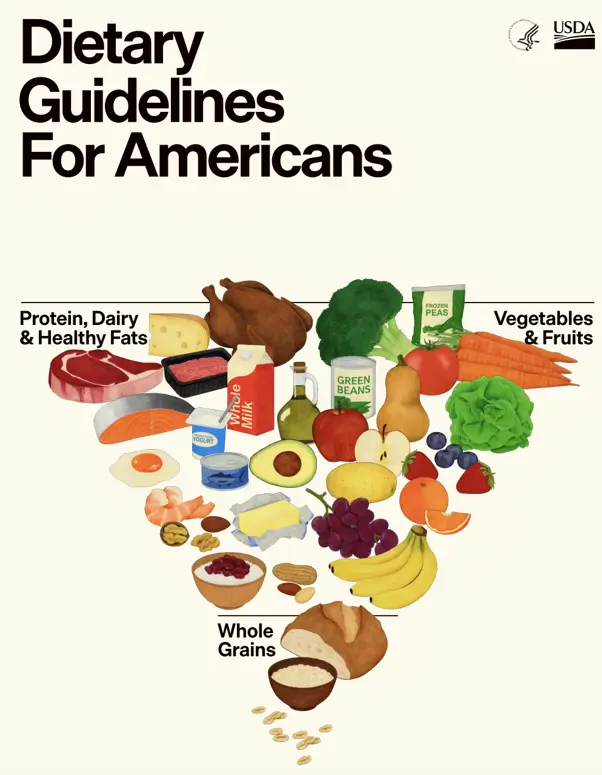

This year a new food pyramid was introduced. You may recall the “old food pyramid” which was wide on the bottom containing a lot of grain, veggies and fruit followed by protein and fat at the top of the pyramid. This was eventually replaced by “My Plate” which had half the plate of fruit and vegetables and the other half protein and grain with dairy products in a circle off to the side. The new food pyramid is actually upside down with the wide part on the top and the point on the bottom. Here is what it got right in my opinion and what I think could still use some “tweaking”.
What the New Nutrition Guidelines Got Right and What Could Be Improved
- The simple message of EAT REAL FOOD is a good one. Our body was meant to eat foods in the most whole form possible. Much of the food in the center of the supermarket aisle is highly processed, highly palatable and well, not in the natural form.
- We need to define what real food is exactly. There are various scores created to actually define “highly processed food” and because processed foods have so deeply infiltrated our food system we are going to have to be more specific and spell it out. One of the most talked about is the Nova Food Classification System which divides foods into four categories:
Group 1 Unprocessed or Minimally Processed (Fruit, Vegetables, Nuts, Meat)
Group 2 Processed Culinary Ingredients (Oil, Butter, Salt and Sugar)
Group 3 Processed Foods (Simple Products which combine Group 1 and 2 – such as a canned vegetable or cheese for example)
Group 4 UltraProcessed Foods (Industrial Formulations with no whole food ingredients and greater than 5 ingredients – sodas and packaged snacks)
Lack of definition of ultraprocessed food of course still leaves some room for confusion. There is a great online resource called TrueFood created by researchers from various organizations including Brigham and Women’s and Harvard where you can type in a food and it lists options from least processed to most processed. Here is the link to TrueFood to try it out for yourself and type in what is currently sitting in your refrigerator or pantry.
https://www.truefood.tech/?store=all
- We need to define what real food is exactly. There are various scores created to actually define “highly processed food” and because processed foods have so deeply infiltrated our food system we are going to have to be more specific and spell it out. One of the most talked about is the Nova Food Classification System which divides foods into four categories:
- Prioritizing Vegetables and Fruit is essential for a healthy diet. The fact that the veggies are front and center at the top of the upside down pyramid is wonderful. This should be the core of our diet. Americans do not eat enough vegetables and fruit in general and the new nutrition guidelines is a call to action to include more color, more fiber and more phytonutrient dense foods.
- While I agree protein is very important, I do not think it deserves equal billing at the top of the pyramid. They include cheese and a large steak at the top. I think red meat can be part of a healthy diet as can some cheese but not in equal portions to the veggies depicted. Calorie for calorie this is misleading. Foods such as steak and cheese are much more calorie dense due to fat content and if trying to maintain weight most of us need to monitor calorie dense foods.
- Protein is highlighted and framed as an important part of the diet and minimum guidelines were increased from the previous minimum of 0.8 g/ kg/ day to 1.2-1.6 g/kg/ day minimum. This is important as our protein needs increase with age and many of us enter middle age with “sarcopenia” and are undermuscled which affects our vitality with aging. Amino acids from protein are essential to increase muscle mass.
- The guidelines go on to say “high quality protein” and this deserves more definition. Food sources, how our animals are raised for consumption and what they are fed is not talked about in the guidelines. If for example our cattle are raised on glyphosate (Round Up) laden corn and they are what they eat……well, then we are too as the consumer of the meat. In addition plant based whole food sources of protein such as legumes are under-represented in the pyramid and guidelines.
- Protein requirements change depending on goals, current muscle mass and age. For example if muscle mass is low then higher amounts of protein are needed. In people aged 65 and older often higher amounts of protein are needed. In younger people with adequate muscle mass and body composition, perhaps lower amounts of protein are better for longevity. Once again- once size does not fit all and it depends on the current state of health and time of life.
- The new guidelines mention the microbiome. The health of the microbiome is critical to human health. I think that the mere fact the guidelines mention fermented food such as kimchi and sauerkraut is a testimony to the vast number of scientific articles published on the importance of intestinal microorganisms to human health.
- There is a call to reduce refined flour and sugar. The new guidelines specifically say to avoid added sugars and refined grain. The Dietary Guidelines specifically says No Amount of added sugars is recommended but if you are consuming as a treat then to limit to no more than 10 grams in a meal. There is also some verbiage in the guidelines about the different names “sugar” is called on packaging – such as beet sugar, maltose and molasses.
- The new guidelines specifically pardon healthy fats. Back in the 1970s and 1980s fat was demonized due to a concern about heart disease. At the time the thinking was that fat in the diet turns into fat in arteries contributing to heart disease risk. We now know that much of the fat in the blood known as cholesterol is made in the liver from sugars and starches. We also know that some fats are even heart healthy such as monounsaturated fats from nuts and omega-3 fats from fish. It is helpful to include fats as part of a healthy diet as it does help with satiety and our body does need some of these fats for optimal function.
- I think the guidelines, while right in not demonizing fats, I do think should have said more regarding the different types of fat such as saturated fat in meat and whole milk. I do not think one should consume a large amount of saturated fats. While saturated fat can be part of a healthy diet I think we should quantify this better. Saturated fat in excess is taken in by the liver and contributes to hepatic triglyceride stores, fatty liver, and metabolic dysfunction as does refined flour and sugar yet this was not called out in the same way.
- The guidelines highlight a personalized approach to caloric intake and macronutrient distribution. Everyone is different and caloric needs vary based on gender, activity and body composition. The new guidelines also mention that chronic diseases may require different dietary eating patterns which I agree with completely. It specifically calls out metabolic related conditions needed for lower carbohydrate based food plans which we often utilize as a strategy in clinical practice.
- A step further could have been taken here in that many people have various food reactions that contribute to chronic disease. For example not everyone may tolerate dairy as a large part of the diet with it being a high antigenic food (the immune system is more likely to react to it) and a portion of the population has a hard time digesting the sugars in dairy such as lactose.
Resources:
https://cdn.realfood.gov/DGA_508.pdf
Monteiro CA, Cannon G, Moubarac JC, Levy RB, Louzada MLC, Jaime PC. The UN Decade of Nutrition, the NOVA food classification and the trouble with ultra-processing. Public Health Nutr. 2018 Jan;21(1):5-17.
https://www.truefood.tech/?store=all