
The Epidemic of Chronic Immune Dysregulation
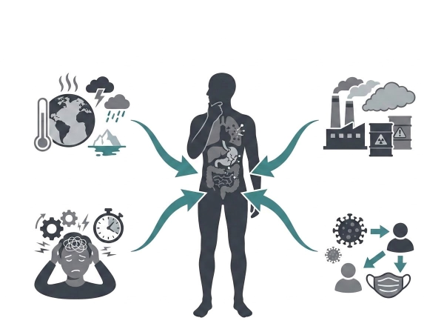
In functional medicine, we put together for each and every patient a timeline or health history. We then map out symptoms on what we call “the matrix” – which divides the body into systems. This is a tool to help us figure out where to start. Human health and symptoms are complex. We try to figure out what will give us the most traction and what is the single next best intervention to move the person forward in their innate healing response. It often makes sense to start in the realm of immune system regulation. I would argue that there are a series of colliding forces that are pushing our immune system to the brink of dysfunction.
Colliding Immune System “Irritants”
Our well-being is tied to the state of our environment. At this juncture in time, it is clear that planetary health directly impacts human biological function. Shifting climate dynamics alter pollen seasons, expand vector-borne disease vectors like ticks, and compromise air quality through events like forest fires—each placing immense strain on our defenses. When coupled with an escalating bioburden—the total array of environmental toxins entering via air, water, diet, and topical exposure—our immune system is kept in a perpetual state of heightened vigilance. Furthermore, mounting societal and political tensions continuously tax our physiology, directly impairing defense mechanisms. Ultimately, the lasting legacy of the COVID-19 pandemic presents an ongoing challenge to human immunity, leaving long-term biological consequences that vary from person to person.
Cell Danger Response
I often use the word “stranger danger” when describing the runaway immune response. This framework for the cell danger response comes out of a paper by Dr Naviaux which puts forward an underlying theory for chronic illness. The body is “stuck” in an inflammatory loop that does not allow for the resolution phase of the healing response. When cells are damaged they release signals which stimulate the immune system. The problem is the immune system responds to said damage as if under attack leading to a chronic inflamed state that self perpetuates. Kind of like revving a car when in neutral- you go nowhere but there is a whole lot of noise and exhaust. I would argue that diagnoses such as Chronic Fatigue Syndrome, Fibromyalgia, Autoimmune Diseases of all kinds, and even Dementia and Asthma can be signs of a dysregulated cell danger response. Ultimately this affects the very core of our cellular being- the mitochondria. Damage to the mitochondria then contributes to changes in metabolic health and accelerates aging.
Idiopathic Mast Cell Activation Syndromes
Mast cells serve as the primary drivers of our allergic and inflammatory cascades. Recent presentations and medical literature suggest that upwards of sixty percent of individuals seeking care exhibit varying degrees of mast cell reactivity—a remarkably elevated prevalence in clinical practice. The following three criteria for diagnosis have been proposed by the European Competence Network on Mastocytosis–American Initiative in Mast Cell Diseases:
- Typical clinical symptoms
- Severe, recurrent (or chronic) symptoms consistent with mast-cell activation, involving at least two organ systems.
- Examples: flushing, urticaria/angioedema, wheeze or throat tightness, hypotension/syncope, tachycardia, abdominal cramping, diarrhea, nausea/vomiting.
- Symptoms must not be better explained by another disorder.
- Biochemical evidence of mast-cell activation
- Preferred marker: serum tryptase drawn during the event, ideally about 30 minutes to 2 hours after symptom onset, compared with a baseline drawn when the patient is well.
- If tryptase is unavailable or does not rise sufficiently, alternatives include elevated urinary N-methylhistamine, prostaglandin D2 or 11β-prostaglandin F2α, or leukotriene E4—preferably measured during/around a symptomatic episode and compared with baseline.
- Response to mast-cell–directed therapy
- A clinically meaningful response to medications that block mast-cell mediator effects or release, such as H1/H2 antihistamines, mast-cell stabilizers, and, when indicated, leukotriene modifiers or anti-kallikrein/other targeted therapies.
In clinical practice, we routinely recognize the first and third criteria pattern in patients with cell danger response- the second one is harder as a flare at the time of lab draw is required so it is less practical clinically. Nevertheless, sometimes we are lucky and “catch” the tryptase or the histamine in bloodwork elevated. It is felt practically that the lack of biochemical evidence should not exclude the diagnosis.
Common Hidden Triggers
In genetically susceptible patients, several underlying drivers frequently perpetuate this state of reactivity:
- Environmental Toxic Burden
- Mold and Mycotoxin Exposure
- Persistent Infections: Viruses, Gastrointestinal Dysbiosis, and Tick-Borne Pathogens
While foundational interventions remain essential, a patient’s health timeline often directs us toward these specific drivers. Achieving clinical improvement requires addressing these underlying irritants alongside immune system regulation. This necessitates targeted objective evaluation. In functional medicine, establishing a clinical diagnosis represents a starting point rather than the final destination. Direct evaluation of immune markers allows us to identify specific activation patterns that map to prospective drivers. This approach provides clarity, particularly when identifying drivers remains challenging or conventional diagnostics prove insufficient—such as standard CDC-recommended assays missing active vector-borne infections.
References:
Naviaux RK. Perspective: Cell danger response Biology-The new science that connects environmental health with mitochondria and the rising tide of chronic illness. Mitochondrion. 2020 Mar;51:40-45. doi: 10.1016/j.mito.2019.12.005. Epub 2019 Dec 23. PMID: 31877376.
Valent P, Akin C, Arock M, Brockow K, Butterfield JH, Carter MC, Castells M, Escribano L, Hartmann K, Lieberman P, Nedoszytko B, Orfao A, Schwartz LB, Sotlar K, Sperr WR, Triggiani M, Valenta R, Horny HP, Metcalfe DD. Definitions, criteria and global classification of mast cell disorders with special reference to mast cell activation syndromes: a consensus proposal. Int Arch Allergy Immunol. 2012;157(3):215-25. doi: 10.1159/000328760. Epub 2011 Oct 27. PMID: 22041891; PMCID: PMC3224511.

Related posts